From Complex Global Processes to an AI-Ready Salesforce Platform
How ADAMA and Tribal are accelerating business transformation across Commercial and R&D


ADAMA is evolving Salesforce from a traditional CRM platform into a broader global business platform. The partnership with Tribal combines AI-enabled platform capabilities with a forward-deployed engineering model to simplify the existing environment, accelerate solution delivery, and build scalable internal capability.
ADAMA's transformation ambition
ADAMA is one of the world's leading crop protection companies, serving farmers and customers in more than 100 countries. Operating at this scale requires the company to connect global capabilities with the specific needs of markets, functions and users across a complex, multi-country organization.
As part of its digital transformation, ADAMA is evolving Salesforce from a traditional CRM platform into a broader business platform that supports commercial execution, forecasting, service and selected cross-functional processes.
The goal is not simply to build more applications. It is to establish a global digital foundation that can:
- Standardize core processes while supporting relevant local needs
- Connect data, workflows and decision-making across countries and functions
- Deliver new capabilities faster and through shorter development cycles
- Make Salesforce easier to govern, maintain and evolve
- Embed AI into everyday business processes in a secure and controlled way
ADAMA's broader Commercial direction is to move from fragmented, country-specific solutions toward global products, reusable digital assets, agile releases, consolidated data and AI-enabled capabilities.
The challenge: transforming faster without adding complexity
ADAMA had already established a substantial Salesforce footprint across 19 countries. However, continued growth created several challenges.
Business requirements were evolving quickly, while traditional delivery models often required long cycles between defining a need and making a working solution available to users. At the same time, the Salesforce environment needed ongoing maintenance, backlog reduction, and stronger governance to support additional innovation.
ADAMA needed a different model, one that could address operational needs and technical debt while also enabling business teams to develop and scale new solutions faster.
The objective was to create a working model in which business experts, ADAMA and Tribal could iterate together, translate requirements rapidly into working functionality, and progressively build more capability inside ADAMA's own teams.
The partnership with Tribal
ADAMA partnered with Tribal to introduce an AI-enabled approach to understanding, maintaining, and extending its Salesforce environment.
The engagement combines the Tribal platform with a forward-deployed engineering model. Instead of treating each requirement as a separate, lengthy implementation project, the teams work through shorter cycles of analysis, design, build, testing, and refinement.
The partnership covers more than individual application development. Its scope includes Salesforce ticket handling, continuous maintenance, monthly enhancements, AI-supported monitoring, and regular improvement-roadmap reviews.
This model supports three complementary objectives:
1. Stabilize and simplify the existing environment
Address backlog, maintenance and accumulated complexity so the platform can evolve with greater confidence.
2. Accelerate business solution delivery
Translate business needs into usable Salesforce capabilities through fast, iterative development.
3. Build a scalable internal capability
Enable ADAMA analysts, administrators, developers and implementation partners to contribute through a shared platform and delivery approach, reducing reliance on a traditional external development model over time.
Use case 1: Creating a common commercial workspace with WinRooms
The business need
Commercial managers require a clear, consistent view of performance, forecasts, customer activity and open issues when reviewing business with their teams.
In a multi-country organization, that information can be distributed across different reports, screens and working files. This makes regular sales discussions more dependent on manual preparation and creates different ways of reviewing performance across countries.
Forecasting presented an additional challenge. ADAMA needed a structured rolling forecast process that could support business reviews and provide stronger visibility and accountability over future expectations.
The solution
ADAMA and Tribal developed WinRooms as a shared commercial workspace for managers and sales teams.
WinRooms brings together key information for regular sales reviews, including performance, forecasts and open cases. It is complemented by a rolling 12-month forecasting capability designed to support a structured and repeatable commercial-management process.
The solution gives managers and account teams a common starting point for their discussions and supports a more consistent management rhythm across markets.
WinRooms is also positioned within ADAMA's strategic Commercial pillars as an enabler for more structured commercial decisions.
.png)
.png)
Why it matters
WinRooms is not simply another dashboard. It represents a product-oriented approach to commercial digitalization.
Rather than developing separate tools for individual countries, ADAMA can build global capabilities, enrich them through country feedback, and make successful functionality available to additional markets. This supports greater reuse, faster improvement cycles, and closer alignment between global direction and local adoption.
The broader roadmap includes WinRooms, rolling forecasting, and further Salesforce-based commercial capabilities, reflecting the shift toward a global, reusable commercial platform.
.png)
Use case 2: Preparing a sales AI agent for global deployment
The business need
Adding a conversational AI experience to a global sales environment requires more than enabling natural-language questions.
The answer provided to a user must reflect that user's role, market, accounts and access rights. A sales representative and a manager may ask the same question but should not necessarily receive the same information.
Before deploying such an agent across 19 countries, ADAMA needed a reliable way to test response relevance, role hierarchies, account visibility and edge cases.
The solution
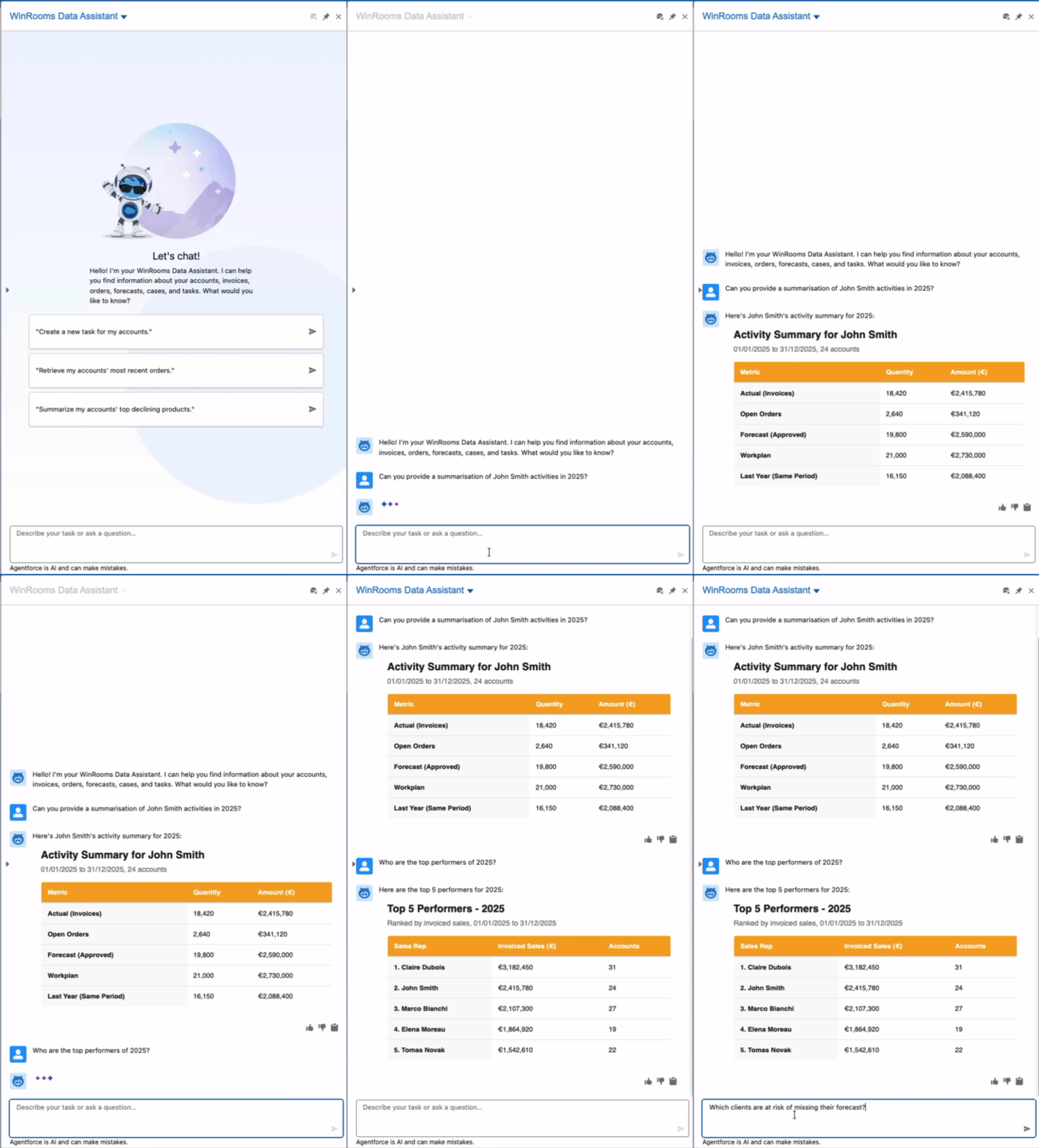
ADAMA and Tribal created an automated evaluation loop for the Salesforce AI agent.
The teams completed 100 evaluation rounds in days, assessing whether the agent's answers were relevant and correctly scoped to the user's role and account access. The project material indicates that performing equivalent testing manually would have required substantially more effort.
Why it matters
The evaluation process helped ADAMA move from an interesting AI demonstration toward a solution designed for production use.
This is especially important in a global enterprise environment, where trust depends not only on the quality of an answer but also on whether the agent consistently respects business context and access permissions.
The initiative also illustrates ADAMA's broader direction: AI should be embedded into existing business platforms and processes, grounded in enterprise data and introduced with the governance required for responsible adoption.
Use case 3: Digitizing the product sample process
The business need
Product sample requests are part of a cross-functional process involving countries, product teams, project managers, and manufacturing sites.
Previously, significant parts of this process were managed through emails and Excel files. This made it difficult to maintain one consistent view of requests, approvals, responsibilities, and progress. It also limited traceability across the complete process.
ADAMA needed a digital workflow that could connect the participating teams, make responsibilities and approvals visible, and provide a reliable process record.
The solution
Working with Tribal, ADAMA developed a role-based Sample Management Portal on Salesforce.
The solution digitizes the process from request through review, approval, and delivery. It provides users with a dedicated workspace while giving relevant stakeholders visibility into the status and history of each request.
The project extended Salesforce beyond its traditional commercial use, bringing approximately 400 R&D-related users into a common digital process.
.png)
Why it matters
The value of the solution is broader than replacing spreadsheets.
It demonstrates that ADAMA can use a trusted enterprise platform to connect R&D, countries, and manufacturing processes, while maintaining role-based access, process transparency and traceability.
It also shows the value of the new delivery approach. A multi-stakeholder process that would traditionally require an extended definition and development cycle was translated into a working Salesforce solution through rapid iterations with the business. Related project materials describe the process as having moved to Salesforce within weeks.
.png)
The emerging impact
The ADAMA and Tribal partnership is creating value at several levels:
- Faster delivery: Business requirements can be translated into working capabilities through shorter, iterative cycles.
- Process transformation: Manual and fragmented workflows can be moved into shared, traceable digital processes.
- Global reuse: Solutions can be designed as global products and enriched through feedback from countries and functions.
- Platform modernization: Maintenance, enhancement and innovation are addressed through one continuous model rather than separate projects.
- AI readiness: Salesforce data, processes, roles and permissions are being prepared to support trusted AI-enabled experiences.
- Capability building: ADAMA's internal teams and implementation partners can increasingly contribute through a common platform and operating model.
The result is not one isolated Salesforce success story. It is an evolving model for how ADAMA can modernize enterprise processes, scale innovation, and make AI part of real business operations.
“Our partnership with Tribal is about much more than developing individual Salesforce applications. Together, we are creating a faster and more scalable way to turn business needs into working digital solutions.
From commercial management and rolling forecasting to cross-functional R&D processes, we are using one enterprise platform to simplify work, improve visibility, and embed AI responsibly into everyday operations. Just as importantly, we are building the internal capabilities required to keep evolving these solutions as our business needs change.”
Nir Rehav
CIO, ADAMA
Looking ahead
ADAMA views the work with Tribal as part of a broader transformation of its Salesforce ecosystem.
The next stage is to continue scaling reusable commercial capabilities, expand adoption, strengthen the internal contributor model, and explore how the same approach can support additional enterprise platforms and processes.
The strategic ambition is clear: move from long, project-based delivery cycles toward a continuously evolving digital platform, one that connects business knowledge, technology and AI to measurable business outcomes.
.png)
.png)