Why We Built Campfire
A customer of ours needed a commission calculator. Their own sales team, their own numbers, their own Salesforce org. The estimate came back as an implementation partner, a six-figure budget, and months of work. So it waited, in a queue behind all the other things that team had quietly stopped asking for.We built that calculator in Campfire, which we are launching today.

.png)
Where the months actually go
The scarce thing in an enterprise is everything that needs to happen between an idea and production.
A business stakeholder writes a requirements doc. An architect designs from that doc, guessing at what the business meant. Security reviews at the end, when changing course is expensive. An admin builds a screen in the shape the ticket described. Weeks later, everyone is surprised by what shipped.
Every handoff drops context. By the fourth one, the thing being built has drifted from the thing that was needed, and nobody can point to the moment it happened.
Meanwhile Salesforce's move toward Headless 360 is opening up how users, agents, and applications interact with the platform. More people and more systems can build on the org. For a company that runs its business on that org, this raises a question worth taking seriously: how do you let more people build without losing control of what they are building on?
One canvas, four people, one problem
Every tribe has a campfire. The place where everyone brings what they know and leaves with something none of them could have made alone.
Campfire is a shared workspace where business users, architects, security teams, admins, reviewers, and testers work on the same change at the same time, grounded in the way the org actually runs today.
Here is a real one.
A manufacturer buried in warranty claims. Assets scattered across the field, parts sitting in third-party depots, reimbursements owed to independent repair partners, and IoT sensors reporting fault codes faster than anyone can act on them.
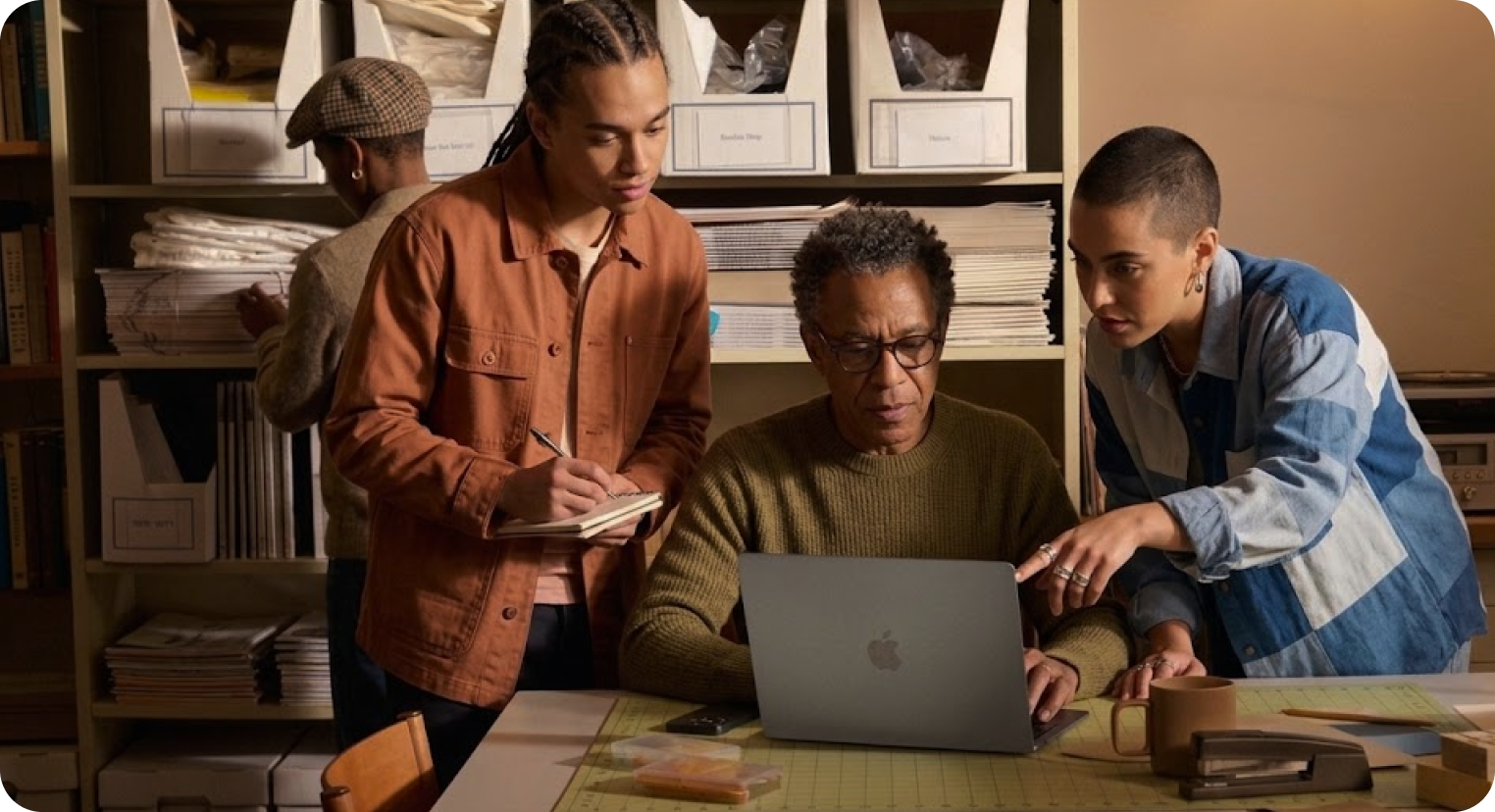
Four people pull up to the same canvas.
The business lead opens with the numbers. Claim volume by product line, average reimbursement cycle, backlog by depot region. Then the ask: an AI agent that catches the defect patterns people miss, and routing that gets each claim to the right specialist team.
The architect looks at what is actually there. IoT telemetry, depot inventory, the partner portal, the Salesforce objects already carrying claim data. They sketch how those pieces connect, working from the org as it exists today.
Security arrives while the topology is still a sketch. They chart how much of the data moving through those integrations is PII, partner financial data, and telemetry, and flag what needs extra access controls before any of it reaches an automated agent.
The admin designs the screen everyone has been describing. Asset health timeline, depot parts availability, a partner reimbursement tracker with the amounts masked, an AI triage recommendation with its confidence score attached. Shaped by the three conversations that came before it.
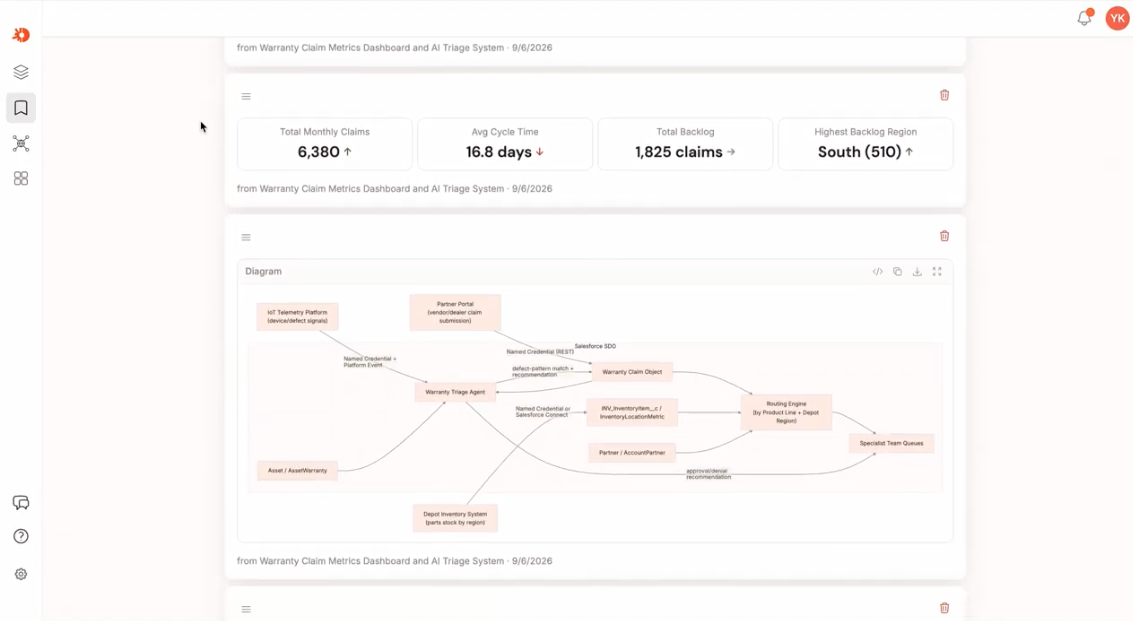
Nothing gets written down and mailed to the next person. By the time the canvas is finished, the four of them already agree on what to build.
The canvas becomes the application
A shared canvas would be worth having on its own. Campfire goes further and turns that canvas into a live project.
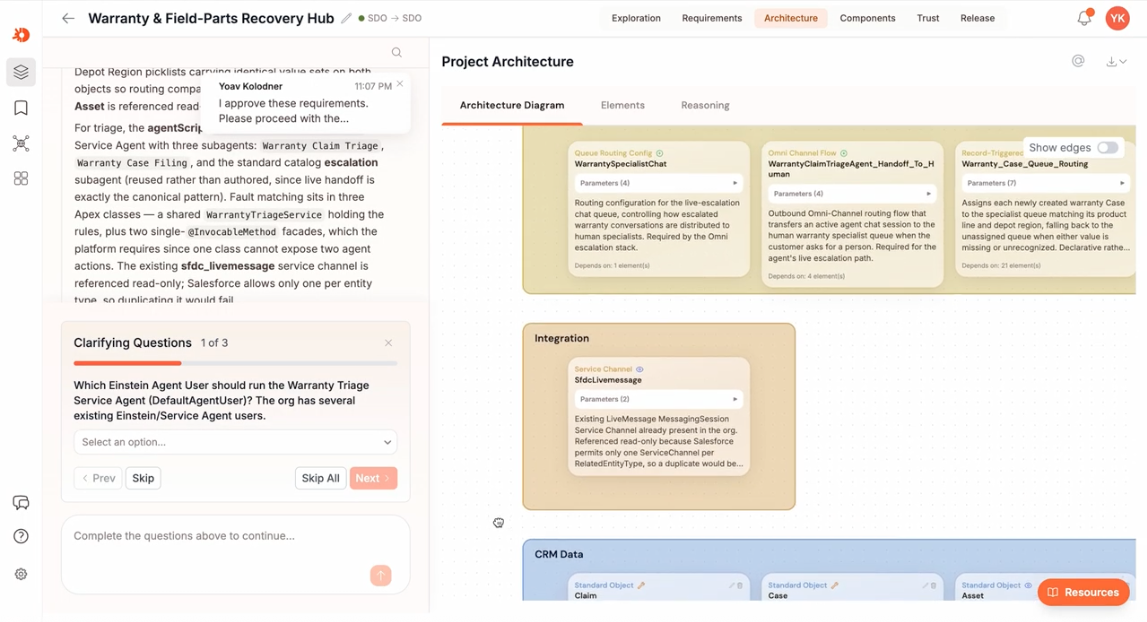
The agreed design becomes an application built on Salesforce technology, including the Agentforce agent the business asked for and the Omni-Channel routing that moves each claim to the right queue. The requirements, workflows, and guardrails the team settled on carry straight through into the build.
Underneath it is Tribal's Metadata Fabric, which continuously maps the org's objects, automations, permissions, business rules, and dependencies. Everyone at the canvas works from that same map. Nobody burns the first two weeks reconciling what four different AI tools each assumed about the org.
Governance holds because it never moved
Applications are built inside Salesforce, so the permissions, governance, and audit controls the company already runs stay exactly where they are. Nothing gets recreated in an external tool. No data leaves the environment.
A business user can shape what gets built without being handed the keys to the org. The people responsible for the system keep oversight of what reaches production. Security gets to set guardrails at the sketch stage, which is the only stage where changing them is cheap.
Admins, architects, and implementation partners stay in the process. What goes away is the translation work between the person who wants the change and the person who has to make it safely.
How Camfire looks in 19 countries
ADAMA, a global crop protection company, used Tribal to support its Agentforce rollout across 19 countries. The usual choice there is one central team guessing at what every market needs, or 19 local builds that drift apart inside a year. ADAMA got a third option. The teams closest to each market shaped their own requirements on a shared foundation, with separation held between markets where local rules called for it.
- "With Tribal, we move significantly faster, iterating quickly and deploying to production with confidence. We're now able to better serve users in 19 countries while streamlining how they work with data across both new and existing markets."
Nir Rehav, CIO, ADAMA
Available now
Campfire is rolling out to customers now. We will be showing it at Dreamforce 2026, September 15 to 17, at Moscone Center in San Francisco. If you are there, come find us.
That commission calculator got built without the implementation partner, the six-figure budget, or the months. What matters more to me is who built it: the people who needed it, sitting with the architect, the security lead, and the admin at the same fire, at the same time.
.png)